
Light Across Cultures
A Reflection for International Day of Light
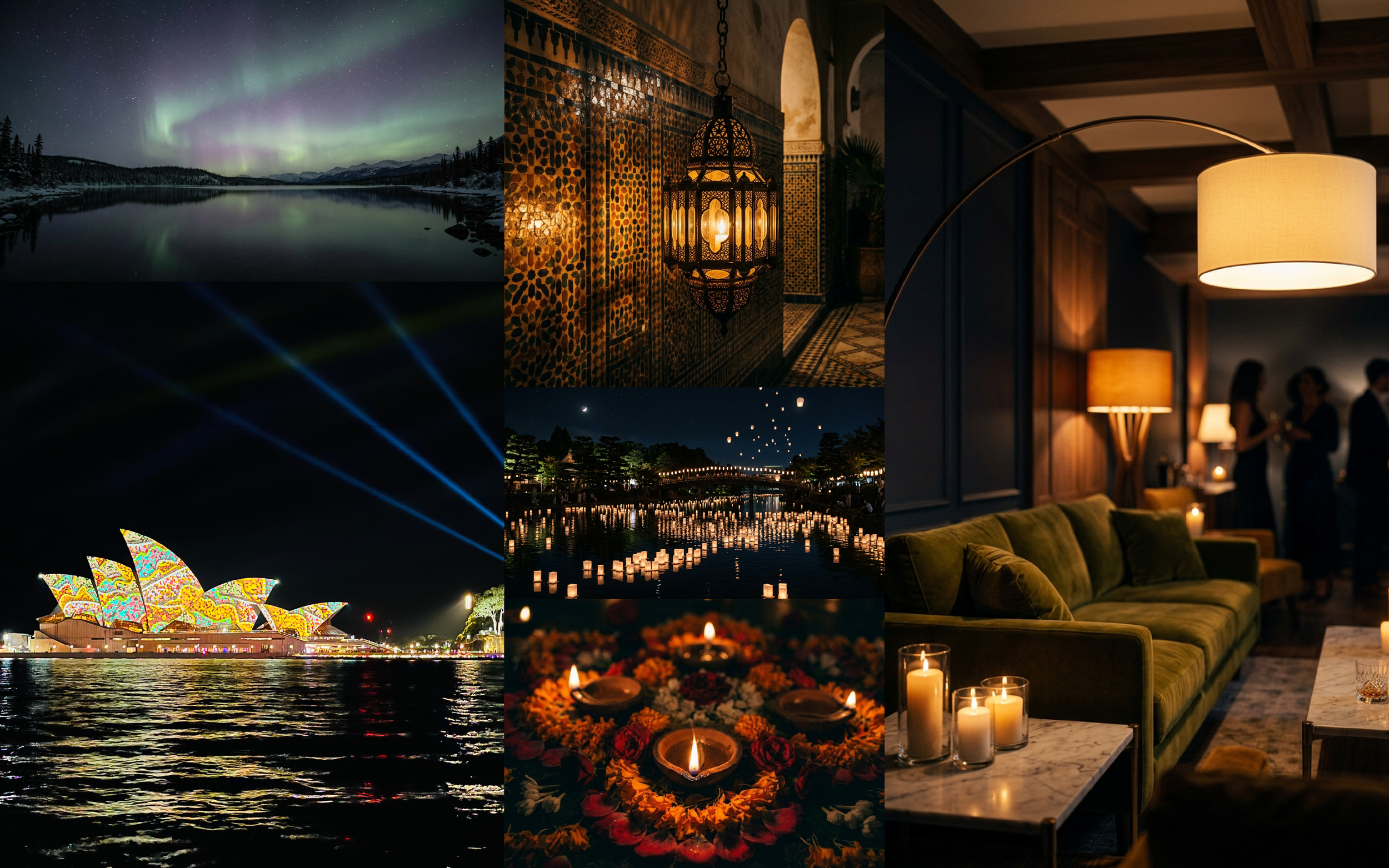
Before we ever lit a candle or strung a lamp, light was already speaking to us. The Aurora Borealis across the Arctic sky moved ancient peoples so deeply, they wove it into their most sacred stories. For the Norse, it was the shining armour of the Valkyries and the Inuit saw the mesmerizing dance of their ancestors. Here, in Australia, the Aurora Australis held equally profound meaning for the First Nations peoples, who interpreted it as a sign of great events unfolding in the spiritual world, almost like a conversation between the living and those who came before. Bioluminescence, the quiet glow of plankton in a dark ocean, fireflies in a monsoon garden, glow worms in a dark tunnel were all interpreted across millennia as magic, as spirits, as the earth itself breathing. These were the most honest responses available to people confronted with something utterly beautiful. That instinct to feel light as something alive, something meaningful has never left us.
That instinct became ritual, and ritual became celebration. In India, where I grew up, Diwali transforms entire cities into something luminous. Millions of oil diyas flickering on doorsteps, rooftops and windowsills mark the return of light over darkness, knowledge over ignorance. In Japan, Obon Matsuri sees delicate chochins or paper lanterns release into rivers and into the night sky, each one carrying the spirit of an ancestor gently home. In Morocco, intricately pierced brass and coloured glass lanterns cast the most extraordinary geometric constellations of light, a reminder that the shape and colour of light can be as intentional and beautiful as the light itself. In the quiet ritual of Hanukkah, a single flame becomes two, four, eight, revealing a story of endurance told entirely in candlelight. Today, that same impulse to gather around light finds expression in festivals that draw thousands of people into the night. Vivid Sydney, right here at home, transforms the harbour and the city into a canvas of light, projection and wonder each winter. Across the world, events like Amsterdam Light Festival, Lyon’s Fete des Lumieres remind us that our relationship with light is not ancient history. It is very much alive.
And then, there is the simplest version of all of this, the one most of us know most intimately. A table, a few candles, the people you love the most, and their faces close and warm in the glow. There is a reason candlelit dinners have never gone out of fashion, and it has nothing to do with romance as a concept. It is the biology of light, the ancient familiarity, the way light pulls people inward and toward each other into a kind of presence that bright light somehow disperses. A home warmly lit at the end of the day, a gathering around a table, the soft radius of a lamp in a favourite chair, these are the moments that stay with us the longest. On this International Day of Light, I find myself thinking less about lumens and colour temperatures and more about this, that light, in it’s most essential form, is an invitation. To gather. To be present. To feel, for a moment, that everything is exactly as it should be.